Floor vs Ceiling: Choosing the Right Golf Simulator Sensor for Your Space

If you're in the early stages of planning a golf simulator setup, one of the first technical decisions you'll face is which type of launch monitor best suits your space. It sounds like a product question, but it's really a space question. The technology you choose should follow from the room you have, not the other way around.
Floor-mounted and ceiling-mounted sensors each have real strengths. Neither is universally better. What matters is understanding how they behave differently, and which one fits your ceiling height, room layout, intended use and budget.
How Each System Works
Floor-mounted sensors sit either behind the golfer or beside the hitting area, using radar, infrared or camera technology to capture ball and club data at the point of impact. They're at eye level with the action, tracking data from the side or from behind as the ball leaves the face.
Ceiling-mounted systems take the opposite approach. The sensor is fixed directly above the hitting zone, looking straight down. Rather than tracking the ball as it flies away, these overhead units capture data at and immediately around the moment of impact, pulling precise spin, launch angle, club path and ball speed from directly above.
Both approaches can deliver highly accurate data. The differences between them become meaningful when you factor in your specific room.
Learn more about what's really possible. Get in touch today for a tailored consultation.

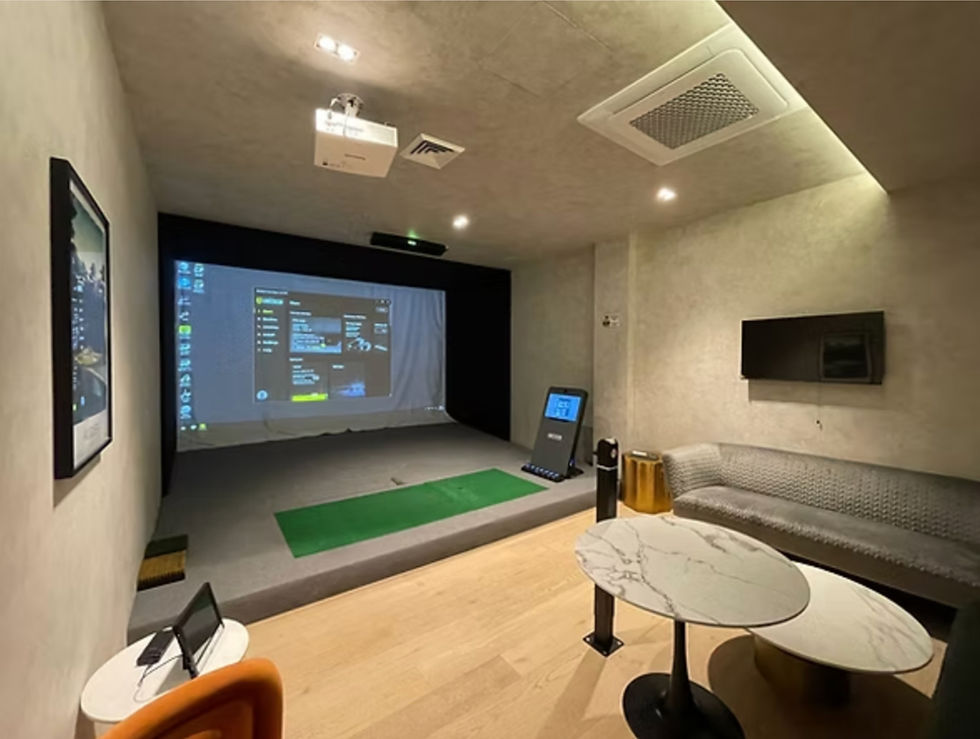
A ceiling-mounted launch monitor keeps the hitting area clear and works across a wider range of club types.

Floor-based sensors sit at ball level to capture data at the point of impact — ideal for tighter spaces with lower ceilings.
The Case for Ceiling-Mounted Systems
Ceiling-mounted sensors are increasingly the preferred choice for permanent, purpose-built simulator rooms, and for good reason.
Because the unit mounts overhead, it leaves the entire floor and side zones of the hitting area completely clear. There's no hardware sitting in your peripheral vision, no risk of striking a floor unit with a follow-through, and no positioning restrictions based on where the sensor needs to sit. Left and right-handed golfers can share the same space without reconfiguring anything. The room feels cleaner, the experience feels more natural.
One detail worth clarifying upfront: whether a system requires marked balls for spin measurement comes down to the specific model and the technology it uses, not whether it's mounted on the floor or the ceiling. Some premium overhead systems can track precise spin data on completely unmarked balls, and some floor-mounted systems can do the same. Equally, certain models in both categories still rely on marked balls for accurate spin data. It's a model-by-model question, so it's worth checking directly rather than assuming based on mounting position.
Where ceiling-mounted systems require careful planning is in ceiling height. A minimum of around 2.7 metres is typically needed to accommodate a full swing without restriction, with 3 metres considered ideal for comfortable use across all clubs, including driver. Anything beyond that is a welcome bonus rather than a necessity. If your room doesn't have the height, a ceiling unit isn't necessarily ruled out, but it does need to be part of the conversation early.

The Case for Floor-Mounted Systems
Floor-mounted sensors solve a problem that ceiling-mounted systems can't: rooms where ceiling height is limited or where structural features make overhead mounting difficult or impossible.
If you're converting a space with a 2.8 metre ceiling, or working with a room that has beams, raked soffits or architectural features that make ceiling mounting impractical, a rear-mounted or side-mounted floor unit may be the more workable option. Some systems are compact enough to install in spaces that would otherwise be considered too constrained for a simulator at all.
Floor-mounted systems also tend to sit at lower price points across the range, which makes them a sensible consideration for builds where budget is a more significant factor. The accuracy of modern floor-based radar and camera systems is genuinely impressive at every level. Entry-level and mid-range floor units provide more than enough data for recreational use, entertainment and social play, while high-end floor systems compete with the best overhead technology on the market.

Which Factors Should Drive Your Decision?
Ceiling height is the starting point. Below approximately 3 metres, ceiling-mounted systems need to be assessed carefully against your specific swing and club preferences. A driver swing requires more clearance than a 7-iron. If ceiling height is right on the threshold, the conversation is worth having before committing to either system.
Room permanence matters too. A permanent, purpose-built room in a new build or a substantial renovation tends to suit overhead installation well, because the infrastructure can be planned around it from the start. A more flexible or temporary setup, or one being retrofitted into an existing space, may find floor-mounted systems easier to accommodate without significant structural work.
Intended use shapes the decision more than people expect. A space built primarily for entertainment and social play has different requirements than one being used for serious game improvement. A golfer who practices daily and wants granular club data benefits from the highest data fidelity available. Someone using the space mostly to host friends on a Saturday afternoon is well served by a solid mid-range system at a fraction of the cost.
Budget across the full range is worth understanding early. Both floor-mounted and ceiling-mounted technology span a wide spectrum from entry-level to professional grade. The most capable systems from either category sit at similar price points. The most accessible entry-level options are almost exclusively floor-mounted. Knowing your budget before choosing a technology type helps avoid over-speccing or under-speccing for the way the room will actually be used.
Left and right-handed golfers using the same space is a practical consideration that often gets overlooked. Ceiling-mounted overhead systems handle ambidextrous setups with no adjustments needed. Some floor-mounted systems require repositioning or have limitations based on handedness, so if the room will be shared, this is worth checking against specific models.

Entry Level vs Advanced: Understanding the Range
One thing worth understanding early is that the technology landscape spans a very wide range. Entry-level floor-mounted systems using basic radar or infrared sensors provide ball speed, carry distance, launch angle and a handful of other data points. That's genuinely enough for recreational play and family entertainment.
A common starting point for clients prioritising budget and simplicity is the Uneekor EYE Mini. It's one of the most accessible ways to get a genuinely capable simulator up and running, particularly when paired with a simple enclosure, and it's a popular choice for exactly that reason: low cost of entry without compromising on the core experience.
At the other end, advanced overhead systems provide upwards of 20 or more club and ball data metrics per shot, including precise face angle, attack angle, spin axis, spin rate, club path and impact location on the face. For golfers using the simulator as a serious practice tool, this level of data changes how they can train.
Most buyers end up somewhere in between. A mid-range system with reliable tracking, realistic course software and a quality projection setup delivers an experience that exceeds expectations for the vast majority of home setups.
The key is being honest about how the room will actually be used, and choosing a system that fits that reality rather than the aspirational version of it.
Let us help you discover what's possible. Get in touch with the team today. Click here.
Getting the Decision Right
The best sensor choice is the one that's been considered alongside everything else: the room's dimensions, ceiling height, structural features, intended use, how many people will use the space, and what the overall experience should feel like day to day.
This is why the technology conversation is most useful when it happens alongside the design conversation, not after it. Room planning, projector throw distance, screen placement, hitting zone positioning and sensor mounting all interact with each other. Getting any one of them wrong can limit what the others can achieve.
If you're in the planning stage and want to work through which system best fits your space, [get in touch with the Golfsim Australia team](https://www.golfsimaustralia.com.au/contact). With the widest range of launch monitor technology available in Australia, from entry-level floor systems through to advanced overhead units, the advice starts with your room, not with a product.
Need help with a decision? The best starting point is a conversation. Get in touch with the Golfsim Australia team

Frequently Asked Questions
Does ceiling height alone determine which system I should use?
It's the most common deciding factor, but not the only one. Budget, intended use, left/right handedness and room permanence all play a role. Ceiling height often narrows the field, but the final decision should take everything into account.
Can ceiling-mounted systems work in a converted garage?
Often yes, particularly for newer or larger garages where ceiling height is generous. Older garages with lower rooflines may require more assessment. A proper ceiling height measurement and swing clearance check should be done before committing.
Do I need marked balls with a ceiling-mounted system?
It depends entirely on the specific model rather than whether it's floor or ceiling-mounted. Some systems in both categories can capture spin data from unmarked balls, while others, in either category, still require marked balls for accurate spin measurement. This is a question worth asking about the exact model you're considering, not something you can assume based on mounting position alone.
Is a floor-mounted system less accurate than an overhead one?
Not necessarily. High-end floor systems are extremely accurate and used in professional environments worldwide. The accuracy gap between systems is more about price tier than mounting position. A premium floor system will outperform a budget overhead unit in most conditions.
What's the most important question to ask before choosing a launch monitor?
How is this room actually going to be used, by whom, and how often? The answer to that question usually makes the right technology choice fairly clear.